Skip to product information
1 of 1

BPC-157 + TB-500

BPC-157 + TB-500

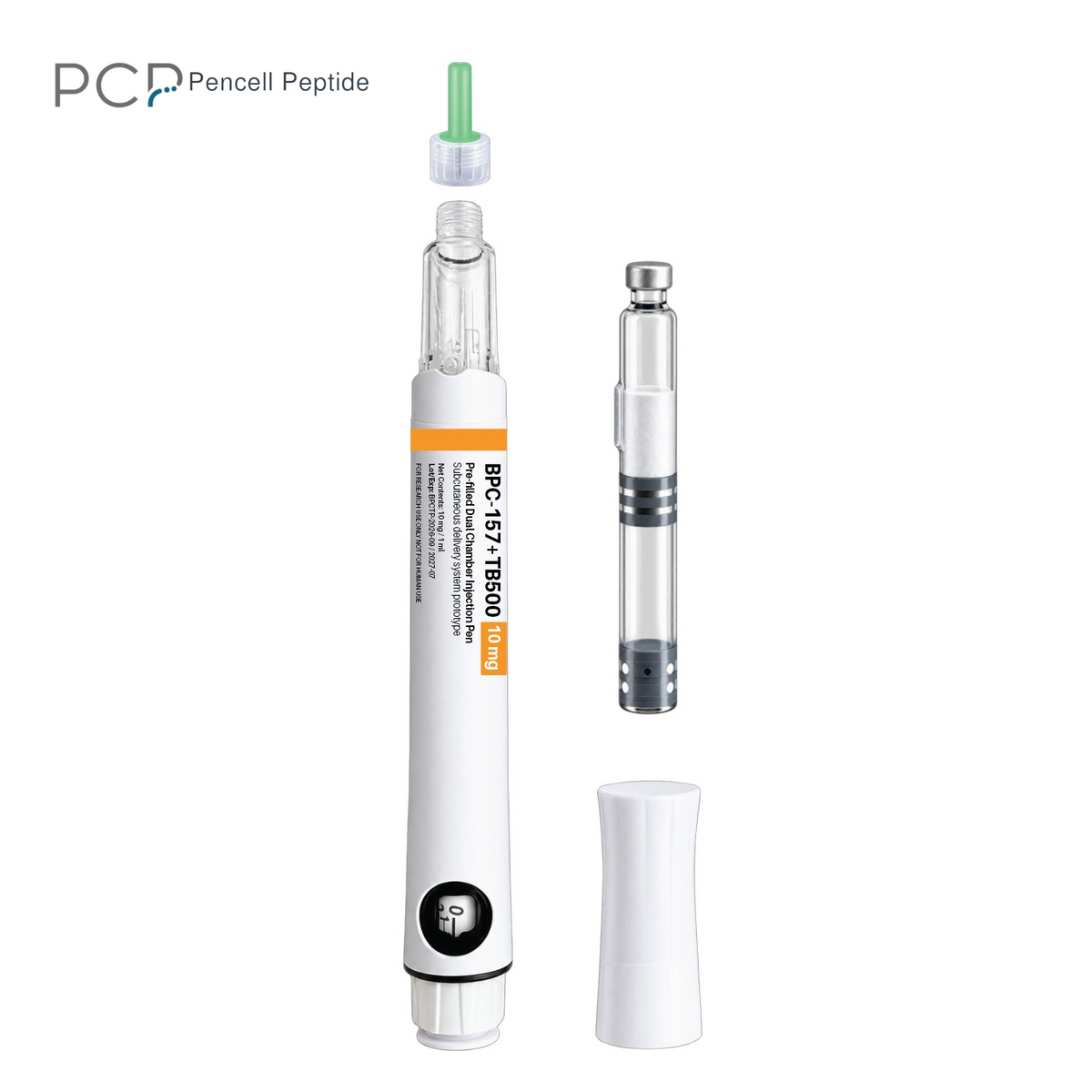
Dual-Chamber Pen

BPC-157 + TB-500 Blend Peptide Pen, commonly known as the “Wolverine” blend, combines two peptides widely studied for their involvement in tissue repair, recovery and regenerative processes.

BPC-157 research has explored tissue healing and gastrointestinal repair, while TB-500-related research has focused on cell migration, wound healing and muscle and connective-tissue recovery. Together, they provide an interesting model for studying complementary repair-related pathways.

The formulation contains 10 mg BPC-157 + 10 mg TB-500. PCP’s proprietary Dual-Chamber Technology keeps the lyophilised blend separate from the bacteriostatic water until activation.

Total peptide content: 20 mg (10 mg BPC-157 + 10 mg TB-500).

For laboratory research use only. Not intended for human or veterinary use.

Strength
Regular price 2.990,00 CZK
Regular price Sale price 2.990,00 CZK
Sale Sold out
Taxes included. Shipping calculated at checkout.
Quantity
Fast, Tracked Shipping
Secure Checkout
COA Available With Lot
Expert Support
Product Details

The BPC-157 + TB-500 Dual-Chamber Research Pen is supplied as a complete, preloaded system containing lyophilised BPC-157 + TB-500 and sterile diluent in two physically separated chambers. The components remain unmixed throughout storage and transport and are combined only when the pen is activated for laboratory preparation.

The 10 mg BPC-157 + 10 mg TB-500 formulation is clearly identified and presented in protective packaging for straightforward product selection, handling and storage within qualified research environments.

Product highlights:

• Proprietary dual-chamber configuration
• Lyophilised BPC-157 + TB-500 and sterile diluent contained separately
• Components remain unmixed until activation
• Contains 10 mg BPC-157 + 10 mg TB-500
• Total peptide content: 20 mg
• Provides 100 dial units in total
• One complete dual-chamber research pen
• Five 32G × 4 mm needle tips included
• Protective packaging for storage and transport
• Certificate of Analysis (COA) available

Technical specifications, storage conditions and handling guidance are provided separately to support accurate product identification and responsible laboratory use.

Technical Specifications
Intended Use
For laboratory research use only. Not for human or veterinary use.
Shipping Condition
Securely packaged for transport with tracked delivery.
Storage Temperature
Unopened/unmixed: store refrigerated at 2–8°C. After mixing: store refrigerated at 2–8°C. Do not freeze. Protect from light.
Presentation
One pre-filled double-chamber research pen containing unmixed components, supplied with three 32G × 4 mm needle tips
Form
Lyophilized peptide powder and diluent maintained in separate chambers
Compound Identity
Compounds: BPC-157 and TB-500

Compound type: Synthetic dual-peptide research formulation

Composition: 10 mg BPC-157 + 10 mg TB-500 (20 mg total peptide content)

Research classification: Investigated in experimental research involving cellular migration, cytoskeletal organisation and repair-associated signalling

Refer to the applicable product and batch documentation for verified analytical, compositional and chemical identity information.
Pen Specifications

Each pen contains a 1 mL cartridge. The amount represented by one dial unit depends on the selected pen strength. The tables below show the corresponding values for each available strength.

Pen Specifications
Pen strength Cartridge 1 dial unit
20 mg 1 mL 0.2 mg

Dial-Unit Conversion Reference

The table shows the amount represented by each listed dial setting for the available pen strengths.

Dial-unit reference by pen strength
Dial units 20 mg
1 0.2 mg
4 0.8 mg
5 1.0 mg
10 2.0 mg
20 4.0 mg
40 8.0 mg

Research-use information: Dial-unit values are provided solely for product identification, quantitative laboratory planning and documentation. They are not administration or clinical dosing instructions.

Storage & Handling

Recommended storage: Unopened/unmixed: store refrigerated at 2–8°C. After mixing: store refrigerated at 2–8°C. Do not freeze. Protect from light.

Protect the product from light and moisture and minimise unnecessary exposure to room temperature.

Complete storage and handling guidance is provided in the product information section below.

Research Use Only

All Pencell Peptide (PCP) products are supplied exclusively for laboratory research use by qualified professionals. They are not intended for human or veterinary use, consumption, personal use, medical, therapeutic, or diagnostic applications. Customers are responsible for lawful purchase, storage, handling, use, and disposal in accordance with applicable regulations and approved laboratory procedures.

View full details

Protected by Design

Peptide and diluent remain separate until preparation

≥98% Purity

HPLC verified for research grade quality

Controlled Conditions

Prepared with a focus on consistency and research quality

Certificate of Analysis

Provided with Every Lot

Scientific Overview

Scientific Background

BPC-157 and TB-500 are synthetic research peptides with different molecular structures and biological profiles. Combining them provides a defined dual-peptide material for investigating cellular organisation, migration and repair-associated signalling from two different mechanistic perspectives.

BPC-157 is a 15-amino-acid peptide studied primarily in preclinical models involving fibroblast activity, cell migration, endothelial responses and tissue-repair signalling. TB-500 is associated with the actin-binding region of thymosin beta-4, a naturally occurring 43-amino-acid peptide. Research in this area has focused on actin regulation, cytoskeletal organisation and cell movement.

This distinction is important: BPC-157 research tends to focus more on repair-associated and cellular responses, while TB-500-related research provides insight into the cytoskeletal mechanisms that enable cells to move and reorganise. Studying them together allows researchers to explore where these pathways may intersect, although a clinically established synergistic effect has not been demonstrated.

Current evidence for both peptides remains predominantly preclinical, with much of the research coming from laboratory and animal models.

This information is provided as general scientific background for laboratory research purposes and does not describe established therapeutic outcomes.
Research Context

Research Applications

Areas examined within controlled laboratory research.

BPC-157 and TB-500 have distinct but complementary research profiles. BPC-157 has been investigated in experimental models involving tissue repair, fibroblast activity, blood-vessel formation and gastrointestinal healing, while TB-500-related research has focused on actin regulation, cell migration, wound repair and connective-tissue processes.

Studying the two peptides within the same formulation provides a model for exploring how these different repair-associated pathways may interact, while the effects of the combined formulation remain an area of investigation.

Current areas of scientific investigation include:

  1. Cell Migration Studies

    Investigation of BPC-157- and TB-500-associated activity in controlled cellular migration assays, including the observation of cell movement and migration-dependent biological responses under defined laboratory conditions.
  2. Fibroblast Activity

    Study of fibroblast behaviour, migration and associated cellular responses in experimental models relevant to connective-tissue organisation and repair-related signalling.
  3. Actin & Cytoskeletal Dynamics

    Research into TB-500-related activity involving actin regulation, cytoskeletal organisation and the cellular mechanisms that support changes in cell shape and movement.
  4. Endothelial Cell Research

    Investigation of endothelial-cell behaviour, migration and associated signalling responses in controlled in-vitro and preclinical research models.
  5. Repair-Associated Signalling

    Study of molecular and cellular signalling responses observed in experimental models of tissue stress, cellular organisation and repair-associated biological processes.
  6. Dual-Peptide Formulation Analysis

    Analytical and comparative evaluation of BPC-157, TB-500 and the combined formulation, including peptide identity, composition, concentration, purity and stability under defined laboratory conditions.
  7. Peptide Structure & Activity

    Comparative investigation of how the distinct amino-acid sequences and molecular characteristics of BPC-157 and TB-500 relate to their observed activity in controlled experimental models.

Studies of BPC-157 and TB-500-related pathways have produced interesting findings in preclinical research, particularly in areas connected with tissue repair and regeneration. BPC-157 has been investigated in experimental models involving wound and tendon healing, blood-vessel formation, gastrointestinal tissue and inflammatory responses.

Research related to TB-500 and its parent protein, thymosin beta-4, has explored cell migration, wound repair, blood-vessel formation and the organisation of actin, a protein that plays an important role in cell movement and tissue structure.

These findings help explain why the two peptides are often discussed together as the “Wolverine” blend. However, most research has examined the compounds or their related pathways separately, and their combination does not have a clinically established synergistic effect.

For laboratory research purposes only. Not intended for human or veterinary use.

Research Use Only View complete notice

All products supplied by Pencell Peptide (PCP), including its dual-chamber peptide research pens, are intended strictly for laboratory research purposes only.

These products are not intended for human or animal consumption, medical or veterinary use, therapeutic applications, diagnostic procedures or any other clinical purpose.

Customers are responsible for complying with all applicable laws, regulations and institutional requirements governing the purchase, possession, handling, storage and use of peptide research materials.

Read the complete Research Use Only notice .